Clopay Garage Door Repair in Providence: A Homeowner’s Guide
If your Clopay door is dented, sagging, or stuck, the right repair depends less on the brand name than on which Clopay line you actually own. Repairing a dented Classic Steel section is often a same-day fix. Repairing a Canyon Ridge composite is a different job entirely, sometimes one where matching a section means ordering from the factory. In Providence, where older homes and newer builds sit side by side, we see both every week. If you’d rather not climb a ladder to sort it out, call (833) 981-3384 and we’ll take a look.
Why so many Clopay doors end up on Providence homes
Clopay is one of the most commonly installed residential door brands in New England, and that shows up across Providence. Walk through neighborhoods on the East Side or Mount Pleasant and you’ll pass Clopay steel doors on older colonials, Clopay insulated doors on renovated two-families, and the occasional Canyon Ridge carriage-style door on a newer build. The brand’s reach is good news for parts availability. It’s less good news for diagnosis, because “it’s a Clopay” tells a technician almost nothing useful.
What matters is the model line, the panel construction, and the door’s weight. A technician who has serviced a hundred Clopay doors but never checked which series they were working on can still order the wrong part, quote the wrong repair, or miss a failure pattern that’s specific to the door in front of them. Familiarity with a brand isn’t the same as knowing its product lines. That gap is where most Clopay repair mistakes in Providence start.
- Classic Steel: Steel sections, uninsulated or lightly insulated, the most common Clopay line on Providence homes.
- Gallery: Insulated steel with a carriage-house look, heavier than Classic Steel.
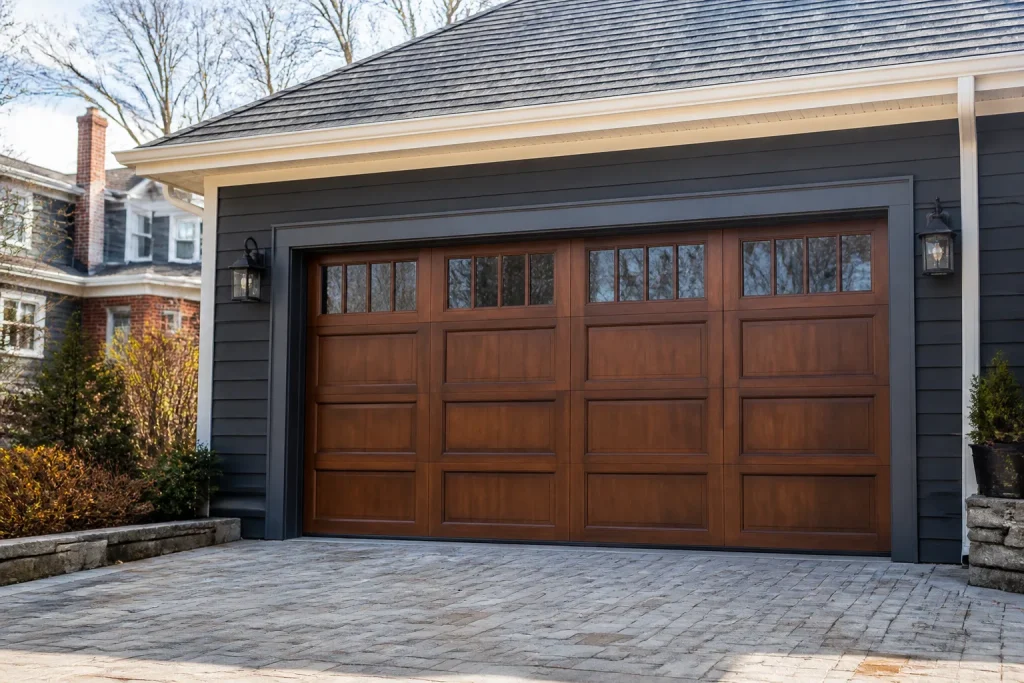
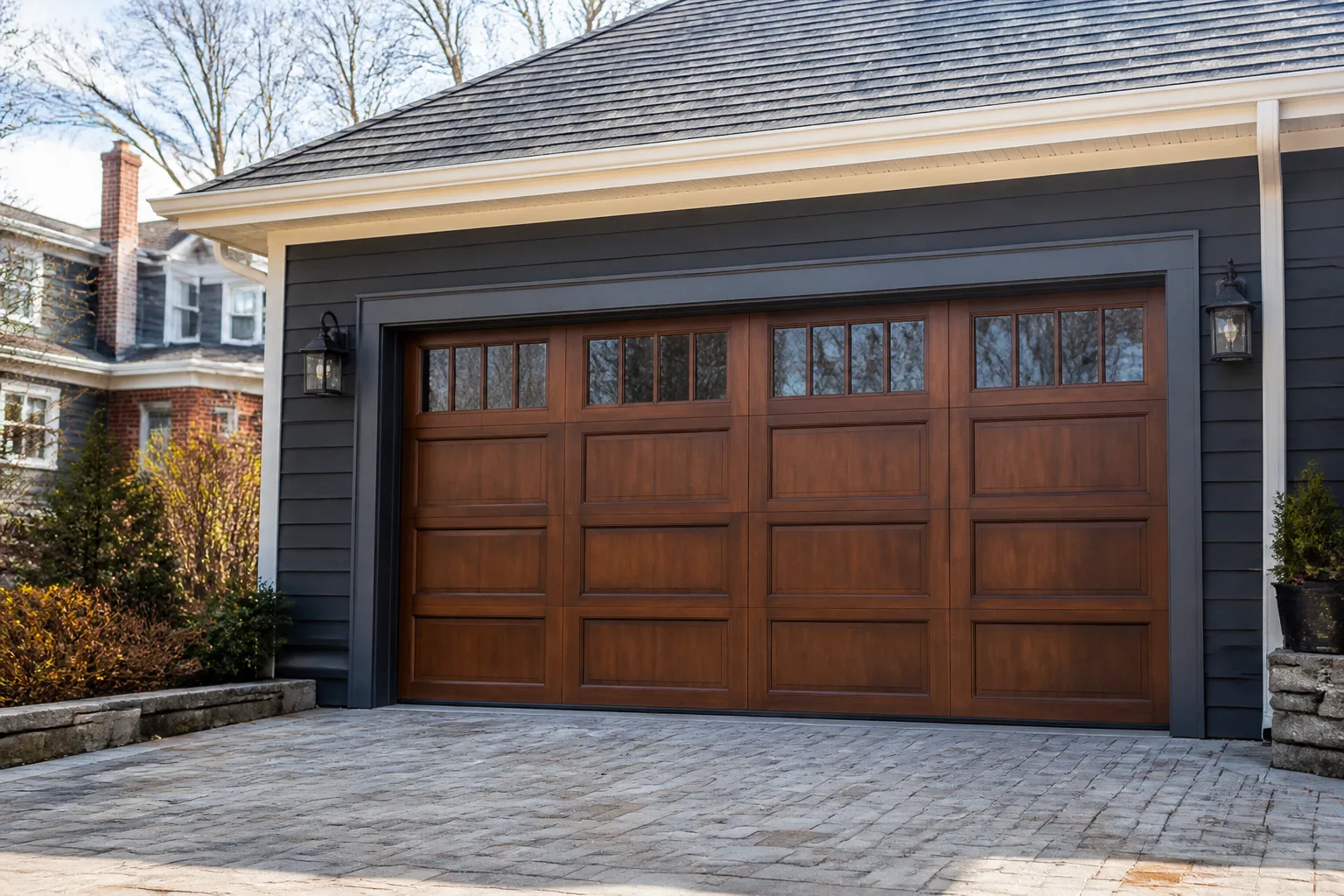
- Canyon Ridge: Composite and steel construction styled to look like wood, the heaviest common Clopay residential line.
- Avante and Modern Steel: Full-view or flush-panel designs with different hardware and section profiles than the traditional raised-panel lines.
How to identify your Clopay door from the inside
You can usually figure out which Clopay line you own without a receipt. Open the door and look at the inside face of a section, then check the end stiles and the bottom bracket area.
- Look for a label or stamp. Clopay usually applies a manufacturer label to the inside of a panel, often near the bottom or on the top section. Model numbers and series names are sometimes printed there.
- Check the section back. Classic Steel doors typically show a flat or lightly ribbed steel back. Insulated lines show a thicker back panel with visible insulation.
- Note the panel thickness. Heavier insulated doors have noticeably thicker sections than uninsulated steel. That thickness matters for springs and hinges.
- Look at the surface texture. A Canyon Ridge door has a composite or wood-look face, not plain painted steel. That single observation changes how any repair is planned.
- Measure the section height. Most residential doors use standard section heights, but not all. If the sections are an unusual size, sourcing a matching replacement gets harder.
Write down whatever you find and snap a photo of the inside label and the bottom bracket. A photo saves a lot of guesswork on the phone, and it lets a technician confirm the line before anyone quotes a repair. If you’d rather skip the detective work, a garage door repair visit can sort out the model and the problem in one trip.
Hardware failures we see on heavier Clopay doors in Providence
Clopay’s insulated doors are heavier than their uninsulated counterparts, and that extra weight shows up in the hardware. In Providence’s climate, where temperatures swing from single digits in winter to humid 90s in summer, the door flexes and the hardware takes the load. The components that fail most often are predictable.
- Bottom brackets: The bracket that anchors the bottom corner of the door takes the most stress of any part. On heavier Clopay doors, a fatigued bracket can crack or pull loose under repeated cycles.
- Rollers: Steel rollers wear flat spots over time. On a heavier door, worn rollers translate into noise, vibration, and extra strain on the opener.
- Hinges: Repeated temperature cycling loosens hinge screws and stresses the hinge leaves, especially on doors that see a lot of daily use.
- Springs and torsion systems: Heavier doors need heavier springs. See the spring section below for why that matters.
Bottom brackets and torsion hardware are the two areas where we tell homeowners to stop and call a pro. Those parts are under serious tension and a mistake there can cause a real injury. We don’t hand out step-by-step instructions for that work, because it isn’t a DIY job.
Clopay springs and torsion systems: why standard charts don’t always fit
Spring sizing on any door comes down to weight, and Clopay’s heavier insulated doors often carry more weight than a technician expects. The standard spring charts many techs carry are useful starting points, but they don’t automatically apply to every Clopay line. A Classic Steel door and a Canyon Ridge door of the same width can need very different springs.
Two things go wrong when a technician sizes a Clopay spring off a chart without weighing the door. First, an undersized spring runs hot, fatigues faster, and can fail sooner than it should. Second, an oversized spring puts more load on the torsion bar, the drums, and the operator than the door was built for. Neither shows up on the day of the repair. Both show up months later.
We weigh the door before quoting a spring replacement, and we treat one spring and a matched pair as separate quotes. Most doors run two springs and both usually get replaced together, but if only one has failed, that’s a conversation, not an automatic upsell. Spring work is a safety-critical repair, so we keep that part in-house with technicians who do it every day rather than handing it off.
Panel damage, section swaps, and the replacement pitch
A cracked or dented Clopay panel doesn’t automatically mean a new door. On a Classic Steel door, a section replacement is often the right call and a much smaller job than a full replacement. On a Canyon Ridge composite, section replacement can be harder to source and may not make sense depending on the damage and the door’s age.
Here’s the honest breakdown of when each option wins:
- Section swap makes sense: damage is confined to one section, the door is relatively new, and the model line is still in production so a matching section is available.
- Section swap gets complicated: damage spans multiple sections, the matching section is discontinued or backordered, or the door’s frame and tracks are also compromised.
- Full replacement makes sense: the door is old enough that replacement hardware no longer matches, several sections are damaged, or the door was already at the end of its service life.
If a technician jumps straight to full replacement without checking whether a matching section is available, get a second opinion. Repairing what’s there is usually the cheaper and more sensible first move. Sometimes the answer really is a new door. That’s a decision to make after looking at the door, not before.
Protecting your Clopay warranty when someone else does the repair
Clopay’s warranty terms are tied to the door and the type of work performed, and the details vary by product line. What matters for a homeowner is that the wrong work, or the wrong part, can affect what Clopay will cover later.
Before any repair, ask two questions. First, will the replacement part be a genuine Clopay part or a compatible aftermarket one, and does the warranty say anything about which is required? Second, will the technician document the work in a way you can reference if you ever need to make a claim? If the answer to either is vague, it’s worth a pause.
Using a technician who’s familiar with Clopay and can answer those questions directly is the most reliable way to avoid a warranty headache later. We can’t speak for Clopay’s decisions on a claim, but we can make sure the repair is done with the right part and documented properly. If you already own a Clopay door and want the repair done with the brand in mind, that’s the whole reason we keep Clopay on our list of systems we service.
When to call a pro
Some Clopay repairs are well within reach for a careful homeowner: replacing a bottom weather seal, swapping a broken roller once tension is off, or tightening a loose hinge screw. Others carry real risk, and it’s not worth the gamble:
- The door won’t open or close, or the opener runs but the door doesn’t move.
- You see a gap in a torsion spring, hear a loud bang from the door, or the door feels very heavy to lift by hand.
- A bottom bracket is cracked, bent, or has pulled away from the door.
- A cable has come off its drum or looks frayed.
- A panel is cracked in a way that compromises the door’s structure.
For any of those, call a trained technician. The same goes for anything involving the opener, whether it’s a LiftMaster, Chamberlain, or Genie unit you’re trying to get working with your door again. A garage door opener repair call can usually diagnose the electronics alongside the door itself, which is handy when the problem could sit in either place.
Related services in Providence: garage door repair for panel, hinge, roller, and cable work; garage door opener repair for LiftMaster, Chamberlain, Genie, and Craftsman units; garage door installation when a full replacement is the right call.
An honest note on the repair-first mindset
We’ve never met a homeowner who was excited to replace a door that just needed a new roller. That’s why our default is to look at what’s failing before we talk about replacing anything. On a heavier Clopay insulated door, that often means inspecting the bottom brackets and rollers with the door’s weight in mind, rather than working from a checklist written for a lighter door.
Every now and then a door really is past saving. When that happens, we’ll say so, and we’ll explain why the section swap won’t fix it. What we won’t do is skip the diagnosis because the brand name looked familiar.
The Bottom Line
- Identify your Clopay line first. Classic Steel, Gallery, and Canyon Ridge doors need different parts and different repair plans.
- Weigh the door before spring work. Standard charts are a starting point, not the final word on heavier insulated Clopay doors.
- Section swaps are often the right call. Don’t accept a full replacement quote until someone has checked whether a matching section is available.
- Ask about parts and documentation. It’s the simplest way to protect your Clopay warranty.
- Leave spring, cable, and bottom-bracket work to a pro. The risk isn’t worth it.
If you’re in Providence and need help with a Clopay door, we offer free estimates and can work with your insurer when a claim is involved. Our technicians have up to 10 years of experience with Clopay and other major brands, and we’re equipped to diagnose the door, the opener, and the hardware in one visit. Call (833) 981-3384 for a free estimate – we’ll quote the work in writing and agree on the price before anything starts.
Frequently Asked Questions
Most Clopay repairs in the Providence area fall into a few typical ranges. A single spring replacement is often quoted around $180 to $340, a pair is roughly double that, roller and hinge work tends to be at the lower end, and a section replacement depends on which Clopay line you own and whether the matching section is in stock. The written estimate sets the final price. Call (833) 981-3384 for an exact quote – estimates are free.
In most cases, yes. A door stuck open is a security problem as much as a mechanical one, and we treat it that way. Same-day emergency response is a core part of what we do, not an add-on. Call (833) 981-3384 and describe what’s happening so we can plan the visit properly.
No. We quote the repair in writing and agree on the price before any work starts. If the diagnosis changes once we’re on site, we’ll explain what changed and get your approval on the new number before continuing. No surprise invoices.
The local pros we connect you with are licensed and insured as their state requires. Spring, cable, and torsion work is performed by technicians trained for that specific repair, since it’s the highest-risk part of any garage door job. If you have questions about credentials before booking, just ask.
Written by the team at Providence Garage Door Repair Pros.
Need Garage Door Help?
Call Providence Garage Door Repair Pros - the local pro we connect you with is licensed and insured, here with fast after-hours help in Providence.
(833) 981-3384